The Future of Digital Inheritance Laws
Legislation is struggling to keep up with our digital lives. From the EU's evolving data rights to US state-level fiduciary access laws, here's where digital inheritance, the legal backbone of digital legacy planning, stands, and where it's headed.
When someone passes away, their physical assets are distributed according to wills, trusts, and inheritance laws refined over centuries. But what about their Gmail account? Their Bitcoin wallet? Their decades of family photos stored in iCloud? The legal frameworks governing digital assets are still in their infancy, and the gap between how we live online and how the law treats that life is one of the defining policy challenges of the 2020s.
The challenge sits at the intersection of three legal traditions that were never designed to overlap: contract law (the terms of service you accept when you sign up), inheritance law (which governs how property moves between generations), and data protection law (which defines the rights of the living data subject). Each has a different theory of what an account 'is,' and the result is a mess that takes lawyers, courts, and platforms years to untangle in any given case.
The Current Landscape
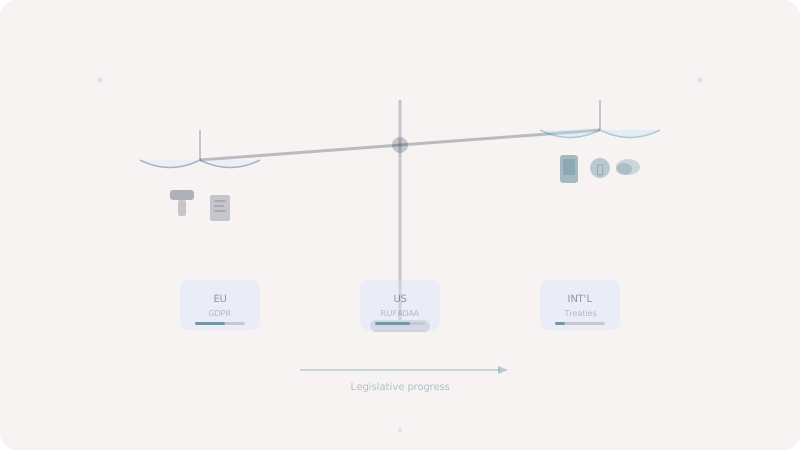
In the United States, the Revised Uniform Fiduciary Access to Digital Assets Act (RUFADAA) has been adopted by most states. It gives executors and trustees the legal authority to manage digital assets, but only if the deceased's terms-of-service agreements and account settings allow it. In practice, most platforms default to denying access, and the burden of proof falls on grieving families. RUFADAA also introduced the concept of an 'online tool': a platform-provided mechanism for naming a legacy contact, which legally overrides anything written in a will.
The European Union takes a rights-based approach. Under GDPR, the right to data portability and erasure exists, but these rights are generally tied to the living data subject. After death, national laws vary widely. France recognizes post-mortem data rights explicitly through the 2016 loi pour une République numérique; Germany relies on general inheritance law applied to digital contexts, with the Federal Court of Justice ruling that Facebook accounts pass to heirs the way physical letters would. The UK, post-Brexit, is charting its own path through a mix of probate reform and platform-specific guidance.
The Platform Problem
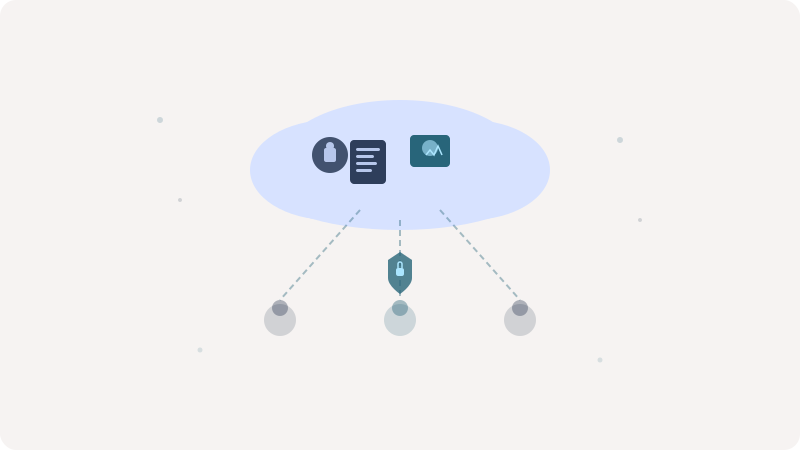
Even where laws exist, enforcement is complicated by platform policies. Apple, Google, Meta, and others each have their own procedures for handling deceased users' accounts. Some offer legacy contact features (Apple's Legacy Contact, Google's Inactive Account Manager, Meta's Memorialization Contact) that let users designate a person in advance. Others require court orders, death certificates, and weeks of back-and-forth correspondence.
The result is a patchwork where your digital inheritance depends as much on which services you used as on the laws of your jurisdiction. A family member with a U.S. estate might pass through ten different procedures to recover ten different accounts, only to learn that several have been silently purged due to inactivity timers.
Crypto and Tokenized Assets
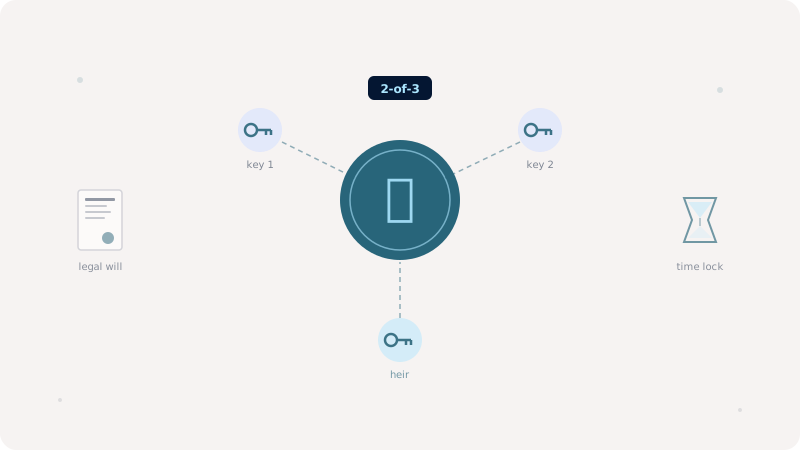
Digital inheritance becomes especially sharp when the assets are bearer instruments like cryptocurrencies. There is no customer service line that can restore a lost seed phrase, no court that can compel a blockchain to recognize an heir. The law can declare your son the legal owner of a bitcoin wallet, but if the private key is gone, the declaration is empty. This is one of the reasons succession planning around self-custodied assets has had to invent entirely new solutions, like multisignature inheritance and time-locked recovery, that cannot be borrowed from traditional estate law.
What Needs to Change
Advocates are pushing for three key reforms: universal default fiduciary access to digital assets, mandatory platform interoperability for estate planning tools, and international treaties that harmonize digital inheritance across borders. Progress is slow, but the direction is clear: the law will eventually catch up to how we actually live. The Hague Conference on Private International Law has begun preliminary work on a digital succession instrument that could become the first cross-border framework.
Why You Shouldn't Wait
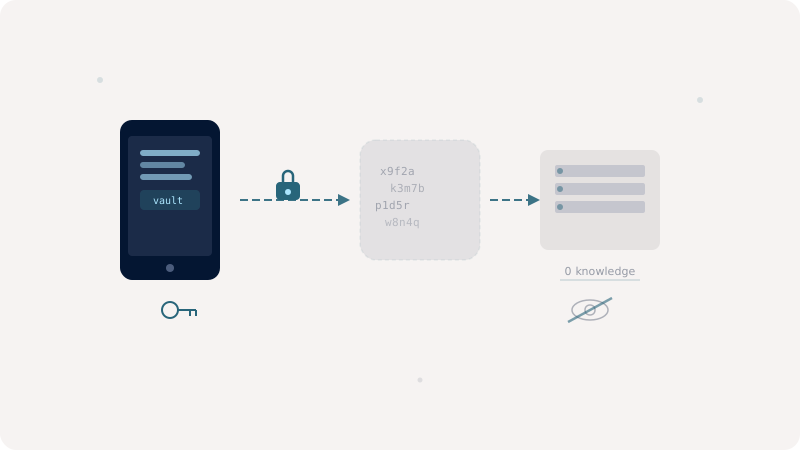
Legal reform moves slowly. Technology doesn't wait. Rather than depending on laws that may take years to evolve, you can take control today. Tools like Keeplas let you define exactly who can access what, under what conditions, using cryptographic guarantees that don't depend on any court order or platform policy. Your digital legacy is too important to leave to legislation that hasn't been written yet.
Combining a legal plan (a properly drafted will, named executors, recognized legacy contacts on the platforms that offer them) with a technical plan (encrypted vault, social recovery quorum, time-locked release) gives your family the strongest possible foundation. Neither layer is sufficient on its own. Both layers together can survive the slow drift of legislation and the rapid drift of platform policy.