Zero-Knowledge Architecture: What It Means for Your Data
The term 'zero-knowledge' gets thrown around a lot. Here's what it actually means, why it matters, and how Keeplas implements it for digital succession, also known as digital legacy planning, to ensure even we can never see your data.
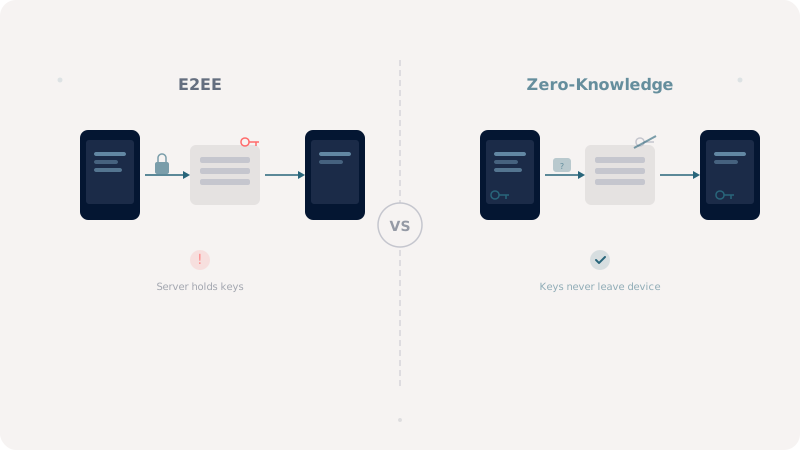
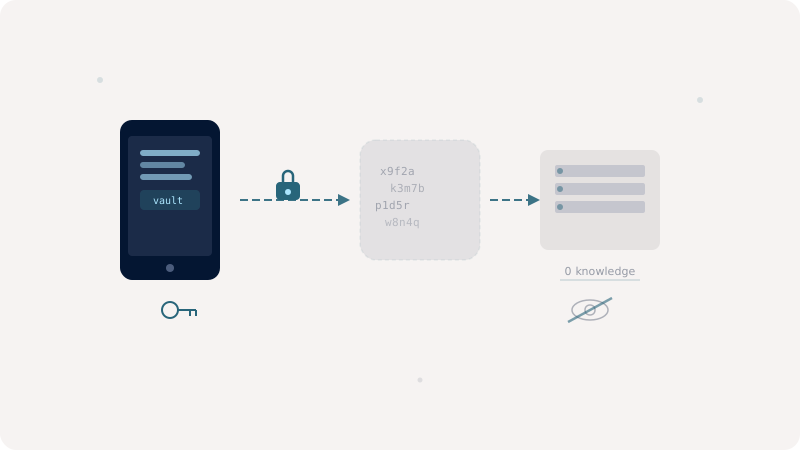
In a zero-knowledge system, the service provider has zero knowledge of your data. Not 'limited access,' not 'encrypted at rest.' Literally zero. The encryption and decryption happen entirely on your device, and the server only ever sees ciphertext it cannot decrypt. This isn't marketing language. It is a verifiable architectural property: if the keys never reach the server, no employee, no attacker, and no court order can compel the company to produce your plaintext, because the company doesn't have it.
The term originates from cryptography, where 'zero-knowledge proofs' allow one party to prove a statement is true without revealing the underlying information. The product-level usage stretches the original meaning, but the spirit is identical: the system should be designed so that knowledge is held by the user and only the user, with mathematics, not promises, enforcing that boundary.
Why It Matters
Most cloud services encrypt your data in transit and at rest, but they hold the keys. This means a data breach, a rogue employee, an internal misconfiguration, or a government subpoena can expose your information. Zero-knowledge eliminates this vector entirely. When the keys never touch the server, the question 'can the provider see my data?' has a mathematical answer instead of a policy answer.
The implications go beyond privacy. Zero-knowledge architectures reduce regulatory exposure for the provider, simplify compliance with frameworks like GDPR and HIPAA, and make subpoena responses dramatically simpler: there is nothing to hand over. For sensitive use cases (estate planning, legal documents, medical records, recovery phrases), this property is not a luxury. It is the only credible foundation.
How Keeplas Implements It
When you create a vault in Keeplas, a 24-word recovery phrase is generated on your device using a cryptographically secure random number generator and never leaves it. From that phrase we derive a Root Key locally using Argon2id, a memory-hard key derivation function chosen specifically because it resists GPU and ASIC brute-force attacks. The Root Key then wraps the AES-256-GCM master key that encrypts your vault contents.
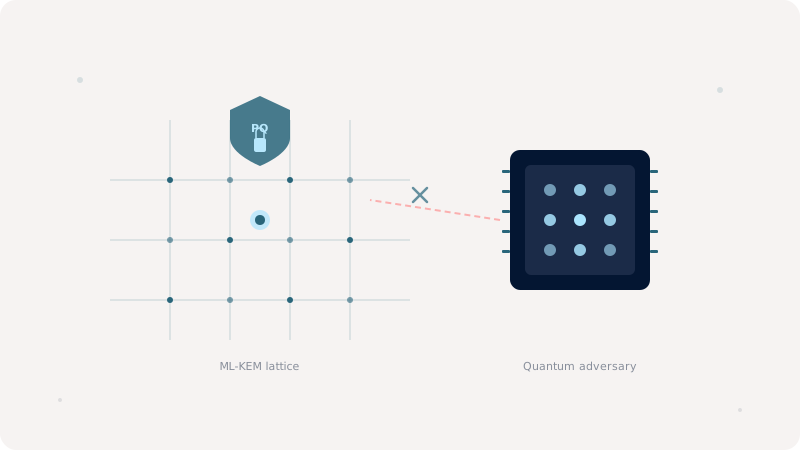
Per-recipient keys and recovery shards are further wrapped with post-quantum ML-KEM-768, a lattice-based algorithm selected by NIST as one of the first standardized defenses against future quantum computers. All of this happens before any network request is made. The plaintext, the recovery phrase, and the derived keys never appear on the wire.
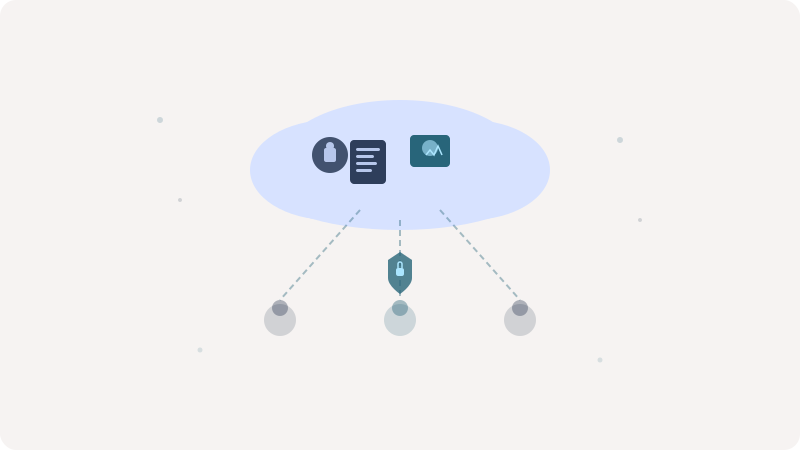
The result is a system where our servers are merely custodians of encrypted blobs. Even if our entire infrastructure were compromised (every database, every backup, every log), your data would remain unreadable without your 24-word recovery phrase or a successful social recovery quorum.
How to Verify a Zero-Knowledge Claim
Zero-knowledge is easy to claim and hard to prove. When evaluating a provider, ask three questions. First, where is the key derived and stored? If the server ever touches the master key or recovery phrase, the property is lost. Second, is the client open source? Without auditable code, you cannot verify that the encryption happens where it claims to. Third, does the system enforce zero-knowledge for account recovery? Many providers degrade to server-held keys the moment you click 'forgot password.'
The Trade-off You Should Know
Zero-knowledge comes with a responsibility: if you lose your 24-word recovery phrase and have no recovery mechanism in place, your data is gone. There is no support ticket, no password reset, no override. That's why Keeplas pairs zero-knowledge with social recovery: a Shamir Secret Sharing scheme, with each shard wrapped in post-quantum ML-KEM-768, that lets trusted contacts help you regain access without ever seeing your data.
This combination, strong client-side cryptography plus human-shaped recovery, gives you the privacy guarantees of a hardware wallet with the resilience of a managed service. It is the architecture digital legacy has been waiting for.