Post-Quantum Cryptography: Why Your Encrypted Data Needs Tomorrow's Math Today
Quantum computers will eventually break the encryption protecting most of today's internet. Here's why post-quantum cryptography matters for digital legacy, and how Keeplas is already ready.
Most of the encryption you rely on every day (HTTPS connections, end-to-end messaging, cryptocurrency wallets, signed software updates) depends on two hard math problems: integer factorization and the discrete logarithm. Both are believed to be intractable on classical computers, which is why algorithms like RSA, Diffie-Hellman, and elliptic-curve cryptography have stood for decades. Both can be solved efficiently by a sufficiently large quantum computer, thanks to Shor's algorithm. That is not a theoretical curiosity. It is a deadline.
Estimates vary on when a cryptographically relevant quantum computer will exist. Some experts say a decade, some say two, some say sooner. But for any data that needs to remain secret for 30 or 50 years (and a digital legacy vault is precisely that), the deadline is effectively today. Attackers can harvest encrypted traffic now and decrypt it later, a strategy known as 'harvest now, decrypt later.' The only defense is to encrypt with algorithms that resist quantum attack from the start.
What Makes an Algorithm 'Post-Quantum'
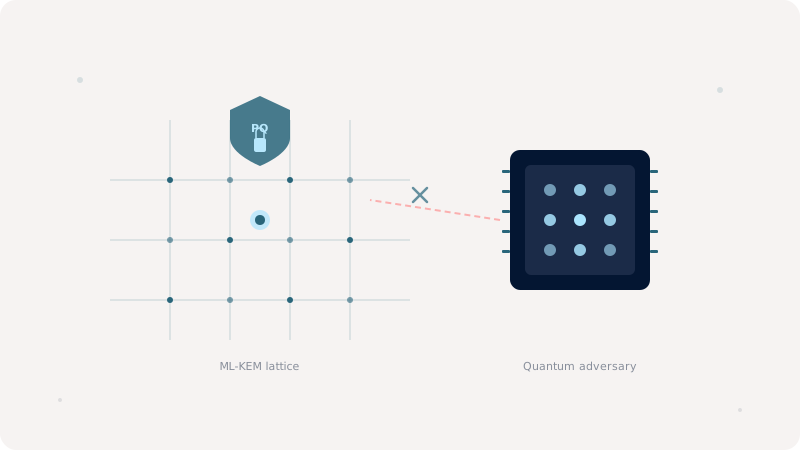
Post-quantum cryptography (PQC) is the family of algorithms whose security rests on math problems that quantum computers are not known to solve efficiently. The leading candidates fall into a few categories: lattice-based, hash-based, code-based, and isogeny-based. After a multi-year evaluation process, NIST standardized the first generation in 2024, including ML-KEM (formerly Kyber) for key encapsulation and ML-DSA (formerly Dilithium) for signatures.
These algorithms are not theoretical drafts. They are now part of TLS libraries, secure messaging protocols, and operating system primitives. Apple, Google, Cloudflare, and Signal have all shipped hybrid post-quantum modes, where classical and post-quantum algorithms are combined so a break in either one alone does not compromise the channel.
Why Digital Succession Cares First
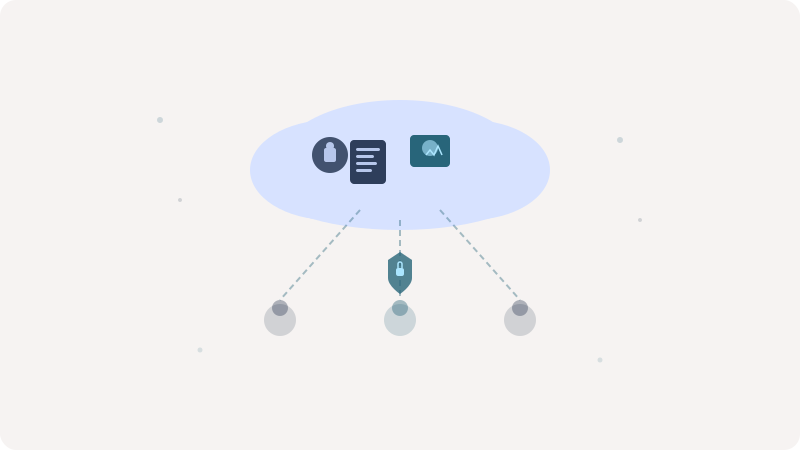
For a chat app, the cost of an algorithm break in 2040 is bounded: today's messages are usually irrelevant in fifteen years. For a digital succession vault, the calculus is inverted. The most valuable items (recovery phrases, identity documents, decades-long photo archives, instructions to heirs) must remain confidential indefinitely. The shelf life of the secret is longer than the expected shelf life of the algorithm protecting it.
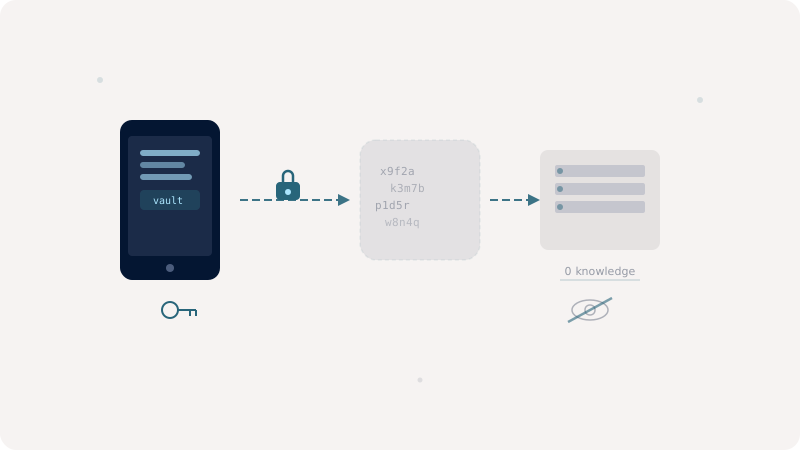
This is why Keeplas chose to integrate ML-KEM-768 from day one, rather than treat it as a future upgrade. Every recovery shard, every per-recipient key wrap, every share that crosses our infrastructure is protected by a post-quantum primitive in addition to classical AES-256. Even if a quantum adversary captures every encrypted blob we ever store, the math is designed to keep your data unreadable.
The Hybrid Approach
Switching cryptography is risky. Old algorithms are mature and battle-tested; new ones, by definition, have fewer years of cryptanalysis behind them. The pragmatic solution is hybrid encryption: combine the classical algorithm with the post-quantum one so that an attacker has to break both to recover the plaintext. This protects against unforeseen weaknesses in the new algorithms while still defending against quantum attacks on the old ones.
What to Ask Your Other Providers
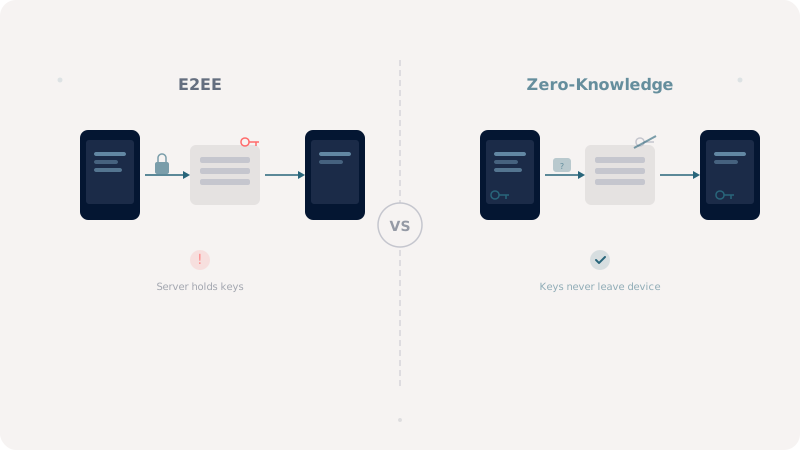
Few consumer services have yet adopted post-quantum cryptography for stored data, even when they claim end-to-end encryption. If you store anything you expect to remain confidential for decades (health records, financial documents, legal instructions, family secrets), ask your providers directly: do you use post-quantum primitives, and if not, what is the migration plan? Their answers will tell you a great deal about how seriously they take the long-term confidentiality of your data.
A Quiet but Important Upgrade
Post-quantum cryptography is one of those infrastructure shifts most users will never notice and yet absolutely depend on. The transition will happen behind the scenes, in standards bodies, code libraries, and software updates. Keeping an eye on which products are leading and which are lagging is one of the few ways an ordinary user can protect themselves against a class of attacks that doesn't yet exist, but eventually will.